



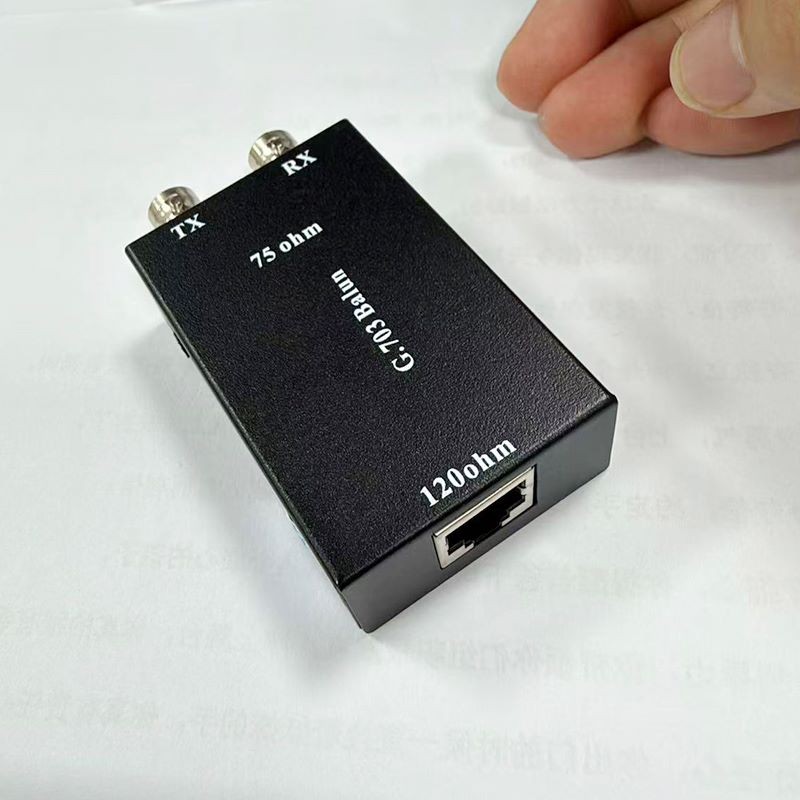


What this balun actually does
This is a G.703 E1 balun that bridges two worlds that speak different electrical languages: a 75 Ω unbalanced coax line on one side and a 120 Ω balanced twisted-pair port on the other. It converts signals in either direction, matches the impedance so reflections stay low, and adds isolation between the line and the equipment. The result is that a standard shielded RJ45 interface can talk to a coax E1 network without swapping hardware or adding active electronics.
Where you will use it
The typical job is at a distribution frame or a router / multiplexer port where the telco hand-off arrives on dual BNC coax but the device only has an RJ45 socket. Telecom installers use these units to run inexpensive shielded twisted pair in place of long coax runs, and to patch a 120 Ω CPE onto a 75 Ω E1 line. It supports ITU-T G.703 unstructured transmission at 2.048 Mbps, and needs no power supply or batteries — the signal itself passes straight through the transformer.
Electrical envelope and pinout
On the coax side there are two female BNC connectors for transmit and receive, intended for RG59 or 2002 cable; the RJ45 side is a shielded 8P8C jack. Typical insertion loss is under 0.2 dB at 2 Mbps with a return loss around -29 dB, and the link-to-data isolation is rated at 500 V AC/DC. The shield follows the G.703 wiring convention — Tx and Rx ground tied to the RJ45 shield through a 0.1 µF capacitor. Because pin assignments differ between DTE and DCE equipment, we make the wiring scheme to your schematic rather than assuming one default.
Configure it to your installation
We build these to order: BNC gender (male or female), wiring scheme, cable fly-lead length and shielding detail are all configurable, and the metal housing can carry your own marking. Send us the connector combination and pinout your installation requires and our engineers will confirm the drawing before production. As a Shenzhen factory we hold the tooling and assembly in house, so OEM/ODM branding, small pilot batches and samples are straightforward — tell us the quantity and we will quote factory-direct with a short lead time.
 008613534059456
 whatsapp:joy
 overseas@hongyian.cn
