


What the zinc alloy shell is actually for
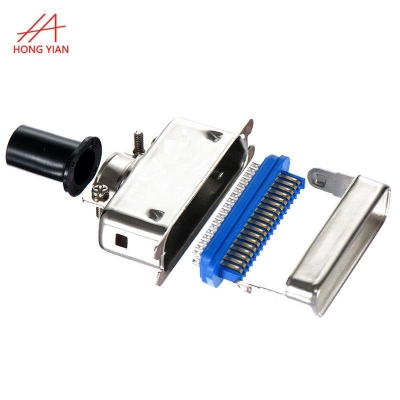
A zinc alloy shell on a SCSI connector is about screening and stiffness rather than looks. It keeps the mating joint rigid when a cable is pulled at an angle, and it gives the drain a metal path to ground for a screened harness. The gold plated contacts sit behind it, rated 1 A typical at 250 V AC. Salt spray testing runs 24 to 48 hours on plated parts like this, which is worth asking about if the assembly goes into a humid cabinet.
Gold plating on a screened connector
Gold over nickel is the usual finish where the joint will be opened for service, because the contact surface does not oxidise in storage. On a cable end that is mated once and left alone, tin is often enough and cheaper, but on a shell like this one the gold finish is normally kept. Contact resistance is 30 mΩ max and insulation resistance 1000 MΩ min across -40 °C to +105 °C.
Ordering a V.26 to a drawing
V.26 is a cable-side shell rather than a board part, so what we need is the contact count, the termination method and the cable it is being fitted to. A photo of the old connector plus the cable OD is often faster than a part number that has been superseded. Small batches of 50 to 100 pcs are normal here, and a reorder after the drawing is frozen matches the first article. The wire harness page shows how we build the cable side.


 008613534059456
 whatsapp:joy
 overseas@hongyian.cn
