


Time:2026-04-10
Views:102
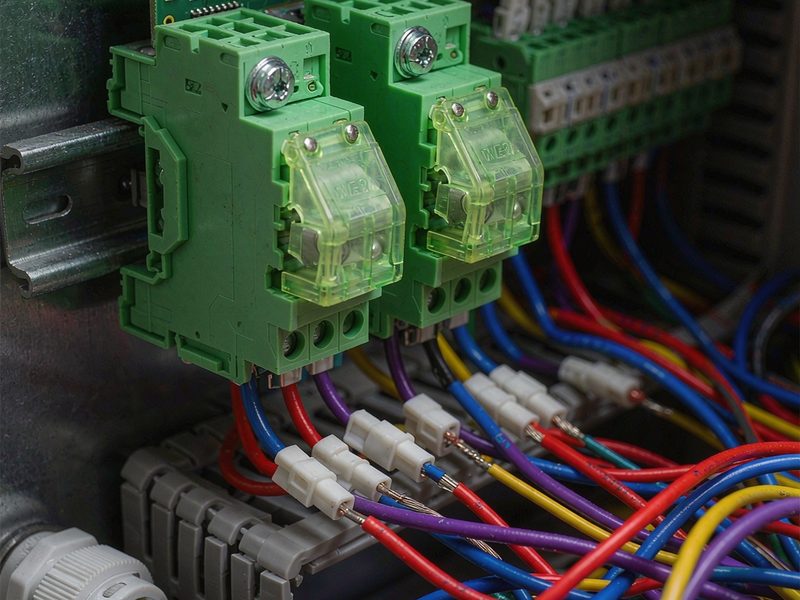
Where bare wires land
A terminal block is a fixed row of screw or spring contacts, usually on a DIN rail or soldered to a PCB. You strip the wire, land it, and tighten it. Control panels and building wiring run on these because the joint is permanent and cheap, and there is nothing to come loose when a cabinet gets moved. The trade is that disconnecting a harness means undoing every conductor.
The two words get used as if they‘re the same thing, but on a panel or a board they mean different parts. A terminal block is where you land bare wires — you strip a wire, push it in, and tighten a screw or a spring clamp. A connector is a plug-and-socket pair where one half mates with the other. One is for terminating wires, the other is for joining two things that unplug.
Terminal block. A terminal block is a fixed row of screw or spring contacts, usually on a DIN rail or soldered to a PCB. It‘s the workhorse of control panels and industrial wiring — think the row of screw terminals inside a machine‘s electrical cabinet. Pitch is the key spec: 2.54mm and 3.5mm for PCBs, 5.0mm and 5.08mm for the classic screw-clamp blocks. You get a current rating per position (a 5.08mm block might do 15A to 20A at 300V), a wire range (say AWG 28 to 12), and a choice of screw, spring, or push-in clamping. The advantage is it‘s permanent and tool-free on the wiring side — strip, insert, tighten, done.
Connector. A connector, in the plug-and-socket sense, is two halves that mate and unmate. It‘s what you use when something has to be disconnected — a removable module, a field-replaceable sensor, a cable that ships separately from the box. It could be a wire-to-board connector, a circular M12, a D-Sub, or anything with a plug on one side and a socket on the other. The point is the mating cycle: connectors are rated for how many times you can plug and unplug them, which is something a terminal block doesn‘t really care about.
Where mating halves make sense
A connector in the plug-and-socket sense is two halves built to separate. Use it for a removable module, a field-replaceable sensor or a harness that has to come apart for shipping. You pay for a second housing and a plated contact, but you get a repeatable mating cycle and a joint an operator can undo without tools.
The hybrid worth knowing. In the real world the two blur together, because a pluggable terminal block is both — it‘s a terminal block that splits into a plug and a header, so you can wire the plug on the bench and then snap it onto the board. That‘s the best of both: screw-clamp wiring convenience plus a disconnect point. If you‘ve ever seen a green two-piece connector with screws on a PCB, that‘s the hybrid.
The decision. If the wires stay put forever, use a fixed terminal block — fewer parts, less cost, nothing to come loose. If you need to disconnect for service or shipping, use a connector or a pluggable terminal block. And if you‘re not sure, tell us how the unit is wired and serviced; that answer usually settles it in a sentence. We stock fixed and pluggable terminal blocks from 2.54mm to 5.08mm, plus wire-to-board and circular connectors, all factory-direct with lead times the big catalogues can‘t match. If you‘re interested, please contact us right away.
Pluggable blocks sit in both camps
The two blur together in real panels because a pluggable terminal block is both: the wire side stays terminated, and the whole block unplugs from the board header. That is a good answer when a cabinet has to be wired once and serviced later. If the wires will never move, a fixed block still costs less and has fewer parts to specify.
Frequently Asked Questions
Is a terminal block a connector?
A terminal block is a type of connector, but it is designed for permanent screw or spring wiring rather than repeated plug and unplug cycles.
When should I use a pluggable terminal block?
When you want easy field wiring plus removable modules - it combines the screw clamp of a terminal block with the mating of a connector.
What wire sizes do you support?
We stock screw terminals, barrier strips and pluggable blocks for typical panel wiring, and can match your wire gauge and pitch.
 008613534059456
 whatsapp:joy
 overseas@hongyian.cn
