



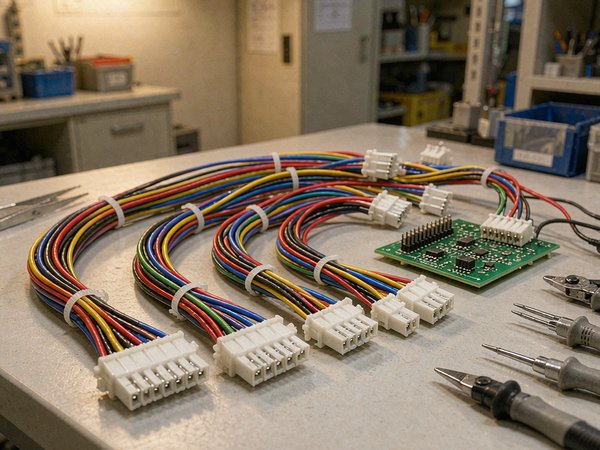
We got a harness back from a customer once with a connector that passed the continuity beep but went open every time the cover was closed. Turned out the crimp was on 30 AWG wire using a terminal meant for 22. It looked fine. It just wasn't. Wire gauge and terminal size is one of those things that nobody argues about until a batch fails in the field, so here's how we match them on the bench.
AWG runs backwards, and that trips people up
Smaller AWG number means thicker wire. 22 AWG is thinner than 16, which is thinner than 12. If you're used to metric, 22 AWG is about 0.33 mm², 16 AWG is roughly 1.3 mm², and 12 AWG comes in near 3.3 mm². Don't eyeball it either. Check the printing on the spool and measure the insulation with a caliper when the batch matters. Mixed-source cable is often not what the label says.
Current rating before anything else
Pick the wire for the current, then find a terminal that can carry it. These are rough chassis-wiring figures in free air, so treat them as a starting point, not a limit you run at:
| Wire | Cross-section | Typical current | Where we see it |
|---|---|---|---|
| 30 AWG | ~0.05 mm² | ~1 A | Fine signal leads, internal sensor links |
| 28 AWG | ~0.08 mm² | ~2 A | Low-power signal, ribbon-style harnesses |
| 26 AWG | ~0.13 mm² | ~3 A | Sensor and control wiring |
| 24 AWG | ~0.20 mm² | ~5 A | General signal, compact I/O |
| 22 AWG | ~0.33 mm² | 7 A | Sensors, XH-class connectors |
| 18 AWG | ~0.82 mm² | 16 A | Automotive accessories, lighting |
| 16 AWG | ~1.3 mm² | 22 A | General power circuits |
| 14 AWG | ~2.1 mm² | 32 A | Power distribution |
Bundle those wires, run them hot, or bury them in loom, and those numbers drop. Derate. A terminal rated at the edge of your current is the wrong terminal, full stop.
Match the terminal to the gauge, not the bag
This is where the JST XH family shows the idea nicely. XH is spec'd for AWG 30 to 22, 3A at AWG 22, 250V AC/DC. But the two common loose terminals don't cover the same window. SXH-001T-P0.6 suits AWG 28 to 22 with insulation OD around 0.9 to 1.9 mm. SXH-002T-P0.6 suits AWG 30 to 26 with OD about 0.9 to 1.3 mm. Put 30 AWG in an SXH-001T and there's too little copper to fill the barrel, so the crimp looks closed but pulls loose. Put 24 AWG in an SXH-002T and the barrel can't close without crushing strands. Both failures are quiet at first. For most 24 AWG sensor wire, SXH-001T is the pick. For a short 28 or 30 AWG internal run, use SXH-002T.
Insulation OD matters as much as the conductor
The crimp has two parts: one grips the copper, one grips the insulation. If the insulation is too fat, it rides into the conductor crimp and you get a joint that conducts today and opens next month. Too thin, and the strain relief does nothing, so bending the wire works the conductor crimp loose. Same AWG can come with thin-wall or thick PVC, silicone or cross-linked insulation. That's why we ask for the insulation OD on a custom harness quote, not just the gauge.
Crimp height is a measurement, not a feel
A crimp that passes a beep test can still be bad. Strands get cut, the locking tang gets flattened, or the height sits just outside spec. On XH terminals the conductor crimp height for 24 AWG targets around 0.70 ± 0.05 mm, with a strip length near 2.1 to 2.6 mm. That target moves with the gauge, so read the table for your wire. Set the ratcheting tool on a scrap piece first, measure with a caliper, adjust, then start the batch. A factory applicator holds this far tighter than a hand tool, which is one reason sourced harnesses with a crimp-height record are worth the money on critical builds.
Three checks before the batch goes out
Pull test, cross-section, contact resistance. Pull a sample crimp and it should hold near the wire's own tensile strength, not slide out of the barrel. Cut one in half and look at the strand deformation under a scope. Measure contact resistance across the joint and compare it with a known-good sample. Doing this on five parts up front beats sorting a thousand in the field. We run these checks on our own harness lines, and we'll share the records for a custom order if you want them.
Factory-direct harnesses, built to your wire list
Brand-name crimp terminals are easy to draw and slow to source. Lead times stretch, reel minimums climb, and a good chunk of the price is the label. We build custom wire harnesses in Shenzhen with XH, PH, VH and JST-compatible terminals, and we'll crimped to your AWG and insulation spec with the right SXH contact in the right housing. Same gauge, same fit, factory-direct pricing, lower MOQs and days instead of quarters. Send the wire list and a photo of the end you're replacing and we'll quote the match.
FAQ
What wire does SXH-001T-P0.6 take?
AWG 28 to 22, insulation OD about 0.9 to 1.9 mm. Most 24 AWG sensor wire is a match.
Can I use 30 AWG with SXH-001T?
You can crimp it, but it'll be weak. Use SXH-002T-P0.6 for 30 to 26 AWG instead.
Is 22 AWG good for 10A?
No. It's rated around 7A in free air, less in a bundle. Step up to 18 or 16 AWG.
Why did my crimp pass continuity but fail later?
Likely a marginal crimp: cut strands, bad height, or insulation in the conductor zone. Beep tests don't catch that.
Do you build harnesses to a specific wire gauge?
We do. Send the AWG, insulation type and connector series and we'll quote a factory-direct build.
 008613534059456
 whatsapp:joy
 overseas@hongyian.cn
