


Time:2026-10-23
Views:4
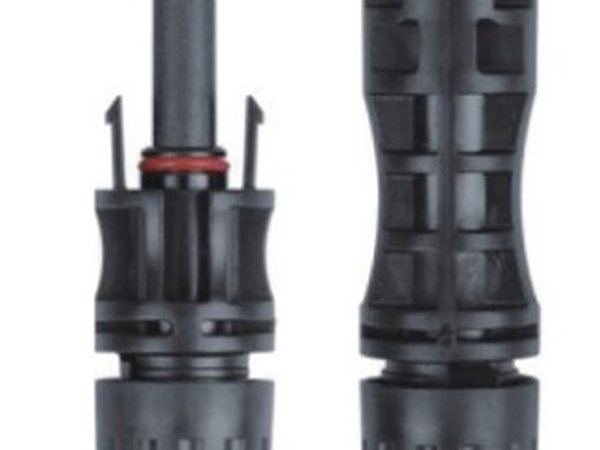
You can't install a solar array without running into the connector question, and it's usually the same one every time: which plug do I actually need, and will it survive on the roof for twenty years. The answer is rarely "just grab an MC4." Real systems mix panel connectors, branch splitters, extension cables, and a few specialty parts, and each one has a voltage rating and an IP rating you have to respect. This guide walks through the whole family the way we sell it from our Shenzhen floor, so you can spec a complete string without guessing.
The MC4 connector is the default, but the voltage matters
MC4 is the industry standard plug for connecting solar panels in series, and it comes in two flavors that people blur together all the time. There's the 1000V version and the 1500V version, and they are not the same part. The 1500V MC4 has a longer creepage path inside the insulator, so you can't safely swap one for the other on a high-voltage string. If your system runs above 1000V DC, you spec the 1500V connector and you check the marking on the housing. Mixing them on one array is how installers get arcing and melted housings. Most residential and small commercial strings run 1000V or under, which is why the 1000V part is what most of our orders ship with.
Branch connectors: when one string becomes two
The moment you parallel two panels or split a string, you need a branch connector. These come in a few shapes. The T-branch splits one line into two at a right angle, and the Y-branch does the same job with two cables angled apart, which is easier to dress along a rail. There are 1-to-2, 1-to-3, and 1-to-4 versions, and they carry the same current you'd expect: a 1-to-3 branch rated at 30A, for instance, means each leg is sized for its share of the total. The key thing we tell buyers is to match the branch's voltage rating to the string. A 1000V branch on a 1500V string is a failure waiting for a hot day. The housing has to be sealed too. Look for IP67 on the branch and on any extension cable connector, because roof connections sit in rain, dust, and direct sun. IP67 means it's dust-tight and survives temporary immersion, which is more than enough for an outdoor array that's mounted and stationary. If you're running cable through a junction that could sit in standing water, go higher or move the connection into a dry box.
Y-branch cable harnesses save a pile of on-site crimping
Instead of hand-crimping three MC4 pigtails in the heat, you can buy a pre-made Y-branch harness with tinned copper PV wire and the connectors already sealed on. We build 1-to-3 and 1-to-4 harnesses with MC4 ends, and a few splitter adapters that just plug in with no crimp tool at all. The wire is double-insulated PV cable rated for outdoor UV, and the ends are sealed so the whole thing ships ready to clip into the string. For an installer doing a dozen roofs a month, the harness pays for itself in labor the first week. You do lose the freedom to cut exact lengths, so measure your rail spacing before you order.
Solar connector types compared
| Type | Voltage | Typical use | Sealing |
|---|---|---|---|
| MC4 panel connector | 1000V or 1500V | Series connection between panels | IP67 |
| MC4.0 panel connector | 1000V | Standard panel lead termination | IP67 |
| T-branch / Y-branch | 1000V / 1500V | Parallel or split a string, 1-to-2 / 1-to-3 / 1-to-4 | IP67 |
| Y-branch cable harness | 1000V / 1500V | Pre-terminated split, tinned copper PV wire | IP67 |
| Extension cable connector | 1000V / 1500V | Extend panel leads, M16 4-pin waterproof | IP67 |
MC4 vs Amphenol H4: can you mix them?
The Amphenol H4 is the other big-name PV connector, and it mates with MC4 in practice because both follow the same TÜV style housing. A lot of inverters and panels ship with H4 ends, and installers plug them straight into MC4 leads without thinking. Mechanically they do intermate, and for most residential jobs that's fine. Where we'd push back is on the price. Branded H4 connectors carry a premium and often a minimum order quantity that makes no sense for a small installer. A factory-direct MC4 from our floor gives you the same intermate, same IP67 rating, at a lower cost and with a low MOQ, and you can spec custom cable lengths or colors without a tooling fee. If your BOM says H4 and the budget is tight, it's a straight swap.
What to check before you order
Four things, and they'll stop a return before it happens. First, the voltage rating, 1000V vs 1500V, matched across the whole string. Second, the branch configuration, because a T and a Y dress differently on the rail. Third, the current rating on each leg, so the splitter actually handles your panel's short-circuit current. And fourth, the cable type and gauge, since PV wire is UV-rated and double-insulated where ordinary building wire is not. Get those four locked in and the connector side of the array basically takes care of itself.
Frequently Asked Questions
What's the difference between 1000V and 1500V MC4?
The 1500V version has a longer creepage path inside the housing, so it's safe on high-voltage strings. Don't mix them on one array.
Can I use a T-branch instead of a Y-branch?
Both split one line into two. A T angles at 90°, a Y angles the cables apart, so it's mostly about how you dress the wire on the rail.
Are MC4 and Amphenol H4 connectors interchangeable?
They intermate mechanically in most cases. H4 just costs more, so factory MC4 is the budget swap.
What IP rating do I need for roof connectors?
IP67 is the safe floor for outdoor arrays. It's dust-tight and handles temporary immersion, which covers rain and sun.
 008613534059456
 whatsapp:joy
 overseas@hongyian.cn
