


DIN 41612 Connector Selection Guide: Type B, C & R Pin Maps and What to Specify
Time:2026-10-09
Views:6
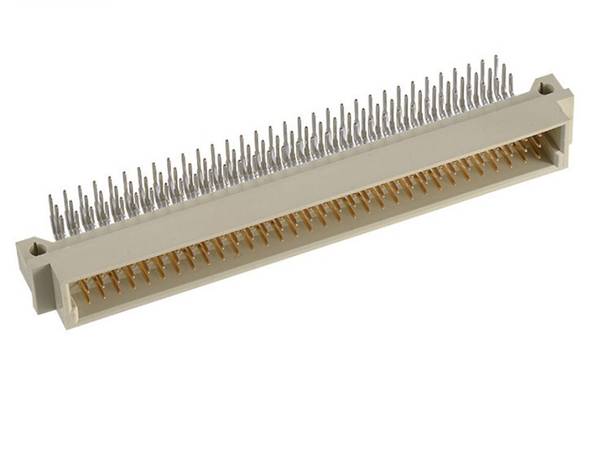
DIN 41612 connectors show up wherever a board plugs into a backplane. The part itself is not complicated, a rectangular housing full of rows of contacts. What trips people up is the naming, because the same physical connector gets called DIN 41612, Eurocard, IEC 60603-2 or just "that 96 pin thing" depending on who you ask. Here's how to cut through it and spec the right one.
The three types you'll actually encounter
The DIN 41612 family splits by pin count and pin shape. Type B has two rows of 32 contacts, so 64 positions total. Type C is the classic 96 position version, three rows of 32. Type R is the half-size version, three rows of 32 but only half as wide. You'll also see Type M, half of a Type B, and Type F, which adds a fourth row for 128 positions. Most designs land on B, C or R, so those are the ones worth knowing cold.
Pin counts and how to read the designation
| Type | Rows | Positions | Contact style | Common use |
|---|---|---|---|---|
| Type B | 2 | 64 | Female / male | Lower density board links |
| Type C | 3 | 96 | Female / male | Eurocard backplane standard |
| Type R | 3 | 48 | Female / male | Half-size Eurocard |
| Type F | 4 | 128 | Female / male | Extra row for grounding |
A 96 position Type C connector is often written as 96P or 3x32. The two numbers you'll see on a drawing are the pin count and the termination style, straight (180°) or right angle (90°). The pitch is always 2.54 mm, and the contact rows sit on a 2.54 mm grid. Once you know type, pin count and angle, you've basically spec'd the part.
What current and voltage do these actually carry
The current rating depends on the contact and how many you load. A standard Type C contact carries about 1.5 A per contact, with a rated voltage around 250 V. For power you can double up contacts, which is what the Type F ground row is for. If a design calls for more than a couple amps per position, DIN 41612 is probably not the right connector and you'd look at a power header instead. It's a signal and low power connector at heart.
IEC 60603-2 part numbers and what they mean
The formal standard behind all of this is IEC 60603-2. Big brands like Harting and ERNI publish their own part numbers that trace back to it, and those are the numbers customers usually have on a BOM. When someone sends us a Harting 09 06 096 or an ERNI drawing, we match it by type, pin count and angle, not by copying the branded number. The mating face is the same, which is the whole point of a standard like this.
That's where a factory helps. Branded DIN 41612 parts carry a premium and often a long lead time, especially for the less common Type R and Type F sizes. We make Type B, C and R in our Shenzhen factory, in both straight and right angle, male and female, and we ship them factory-direct with lower MOQs than the big distributors. Same 2.54 mm pitch, same mating interface, no brand markup.
If you've got a drawing with a DIN 41612 on it and you're not sure which type it is, send it over. We'll read the pin map and confirm the exact type and count before anything gets quoted.
Frequently Asked Questions
What is the difference between DIN 41612 Type B and Type C?
Type B has two rows of 32 for 64 positions, Type C has three rows of 32 for 96 positions. Same pitch, different density.
How much current can a DIN 41612 contact carry?
About 1.5 A per contact at 250 V. It's a signal and low power connector, not a power connector.
Is DIN 41612 the same as IEC 60603-2?
Yes. IEC 60603-2 is the formal standard, and DIN 41612 is the common name for the same connectors.
What does 96P mean on a DIN 41612 drawing?
96 positions, which is a three-row Type C connector. It's the standard Eurocard backplane size.
 008613534059456
 whatsapp:joy
 overseas@hongyian.cn
