


Female Header Connector Selection Guide: Pitch, Rows and Part Numbers Explained
Time:2025-09-16
Views:1
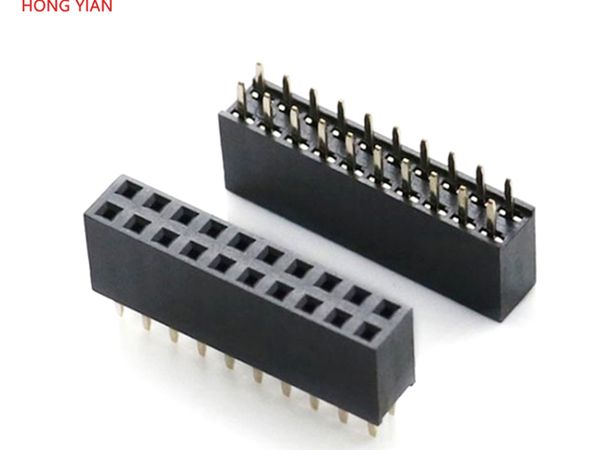
A female header is the socket half of a board-to-board or wire-to-board connection, and if you've ever stared at a BOM line that just says "2.54mm 2x20P female header" you know the spec sheet never tells you enough. Pitch, row count, orientation, contact type, the plastic height. Get any one of those wrong and the mating board won't line up. This page walks through what actually matters, and how to write a part number that a factory in Shenzhen can quote without a dozen back-and-forth emails.
Start with pitch, everything else follows
Pitch is the distance from the center of one pin to the next. For female headers the common ones are 1.27mm, 2.0mm and 2.54mm, and you'll also run into 3.96mm when a design carries a bit more current. 2.54mm is the everyday workhorse for prototyping and general board stacking. 2.0mm shows up where space is tight, and 1.27mm is for dense SMT boards. The pitch has to match the male pin header you're mating with, so decide both together, not one at a time.
Rows, positions and how to read the numbers
A female header is described by rows and positions. "2x20P" means two rows of 20, so 40 positions total. "1x4P" is a single row of four. The row spacing follows the pitch in most cases, so a 2.54mm dual row header has 2.54mm between rows too. When you see a drawing that says 2.54mm 2x10P H7.1mm, the H is the profile height of the plastic body, and that's the number that catches most people out, because it decides whether the mated stack sits flat or floats.
Straight, right angle and the SMT split
The next call is orientation. A straight (180 degree) header sits vertical on the board, pins pointing up. A right angle (90 degree) header lies flat so the board can plug in from the side. Then you pick the termination. Through-hole, or DIP, has pins that go through the board. SMT has surface pads. SMT saves assembly steps and works for 1.27mm and 2.0mm fine pitch parts, but DIP is stronger when a connector is going to be pulled and re-plugged often. If the connector will see vibration, go DIP. If it's a one-time board build, SMT is cheaper to place.
Contact type matters more than people admit
There are two contact styles worth separating. Stamped and formed contacts are punched from flat strip and are the budget option. Machined or "round pin" contacts are turned on a lathe and give a more solid, lower-resistance connection, and they hold up better to repeated mating. We call the round-pin version a round pin female header. If the board is going to be mated and unmated a lot, or if it carries a signal you can't afford to lose, spend the little extra on machined contacts.
Common female header specs at a look
| Pitch | Rows | Typical positions | Contact style | Common use |
|---|---|---|---|---|
| 1.27mm | 1 / 2 | 1x40P, 2x40P | Machined / stamped | Dense SMT boards |
| 2.0mm | 1 / 2 | 1x4P to 1x40P | Stamped / machined | Compact consumer boards |
| 2.54mm | 1 / 2 | 1x2P to 2x40P | Stamped / machined | Prototyping, board stacking |
| 3.96mm | 1 / 2 | 1x2P to 2x6P | Stamped | Higher current links |
The plastic body is usually PA6T or LCP for the SMT parts, because those survive the reflow oven without warping. Cheaper through-hole headers sometimes use PBT or PA66. If you're reflowing at 260°C, spec a high-temp material or the housing will sag.
Writing a part number that gets quoted fast
Put the spec in one clean line and a factory can quote it in a day instead of a week. Something like: 2.54mm dual row straight female header, 2x20P, H8.5mm, gold flash, PA6T. That's pitch, rows, orientation, positions, profile height, plating and body material. You don't need the exact part number from a catalog. We build these to the spec, and we can match the footprint of branded parts if that's what your board was laid out for.
Matching branded headers without the premium
A lot of female headers on BOMs are drop-in replacements for the usual names, and the branded versions carry the usual brand markup, long lead times and minimum order quantities that don't suit a small build. As a factory in Shenzhen, Guangdong, we make the same 1.27mm, 2.0mm, 2.54mm and 3.96mm headers to the same footprints, factory-direct, with lower MOQs and shorter lead times. Same pitch, same profile height, same mating performance, a good deal less money. If you're tired of waiting on catalog stock, that's the whole pitch.
Frequently Asked Questions
What is the difference between a female header and a male pin header?
The female header has sockets, the male header has pins. They mate together to join two boards.
What does 2x20P mean on a female header?
Two rows of 20 positions, so 40 contacts total. It's the standard way to write pin counts.
What pitch should I use for a female header?
2.54mm is the default. Use 2.0mm or 1.27mm when the board is dense and space is tight.
Can a female header replace a branded part?
Yes, if the pitch, rows and profile height match. We build to the same footprint at factory-direct prices.
 008613534059456
 whatsapp:joy
 overseas@hongyian.cn
