



A barrier between every pair of wires
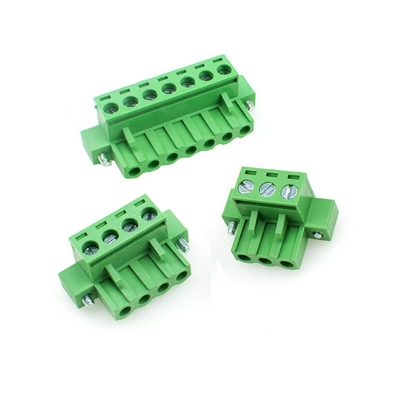
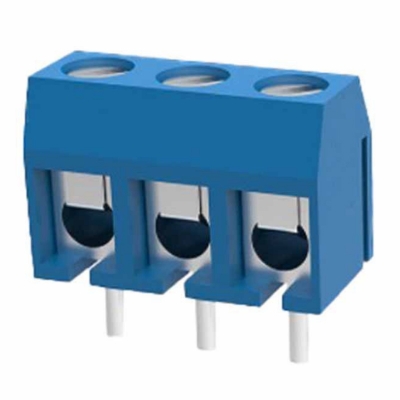
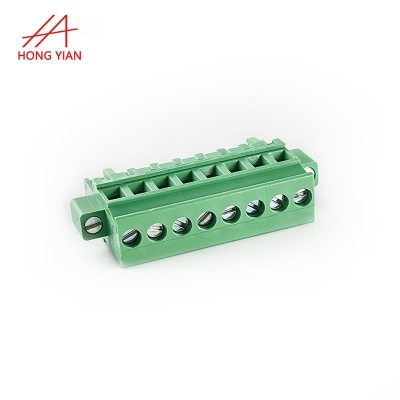
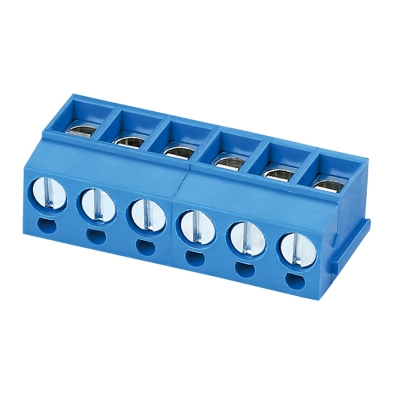
A fence terminal block puts a raised wall between adjacent circuits, so a stray strand at one entry cannot lean into the next. At 7.62 mm the walls are far enough apart to take a ring terminal or a bare conductor comfortably, and the American gauge callout tells you the wire sizes the clamp was shaped for. This is the style you reach for on a panel where several different potentials sit shoulder to shoulder and a screwdriver has to work between them without slipping.
Twenty amps and what the barrier is really doing
The block carries 20.0 A typical at 300 V AC typical, with 20 mΩ max at the contact. Twenty amps through that resistance is roughly 8 W per pole, which is why the barrier matters electrically as well as mechanically: it keeps the hot contact and its neighbour from sharing heat. Insulation resistance is 100 MΩ min and the dielectric test is 2500 V AC typical. Operating range is -40 °C to +105 °C typical, covering an unheated cabinet as well as a warm one.
Match the gauge the clamp was cut for
Tell us the AWG you are landing and we will confirm the clamp opening before quoting, because an oversized strand at the mouth of a fence block is a cheat that shows up later as a loose joint. Common counts sit in stock and go out in eight working days. Custom pole counts follow the drawing and leave in 10 to 12 working days with the barrier layout printed on the traveller.
 008613534059456
 whatsapp:joy
 overseas@hongyian.cn
