


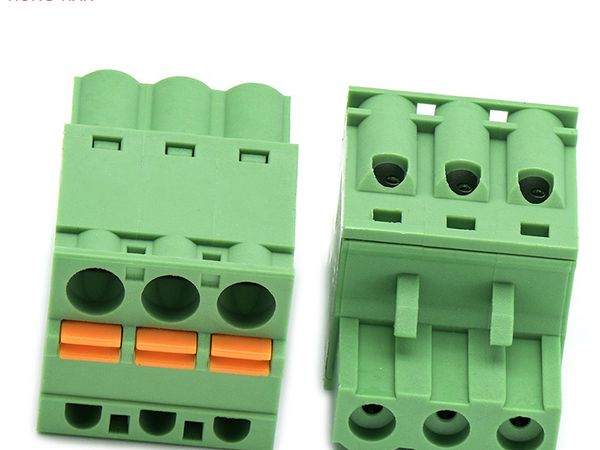
Most people only think about terminal blocks when a PCB is already laid out and there's no room for the connector they actually wanted. That's how a lot of our orders start. An engineer calls in with a 5.0mm footprint already routed, needs the header to drop in, and we point them at the right pluggable part the same day.
First decide how the wires actually terminate
There's no single "best" terminal block. It depends on whether you're screwing the wire in by hand, pushing it in without a tool, or mating two halves so the board half stays soldered while the wiring half unplugs. We break it into three families:
- Screw / barrier terminal blocks. The wire goes under a clamp or a screw cage. Most forgiving for field wiring, works with ferrules and bare stranded copper, and handles the highest current. Pitches run 5.08mm up to 9.5mm and 11mm on the big barrier blocks.
- Pluggable terminal blocks. Two pieces. The header is soldered to the PCB, the plug carries the wire and unplugs for service. This is what you want when the board ships separate from the wiring harness.
- Spring / push-in. No screw, just push the wire in. Faster on the assembly line, but you give up a bit of current and it's pickier about wire gauge.
If you're not sure, ask yourself one question: does the wire ever need to come off without a screwdriver? Yes, go pluggable. No, screw is fine and it's cheaper.
Pitch is the first number that matters
The pitch is the distance between poles. It sets the current rating and, more importantly, what footprints already exist on your board. Here's how we usually see them get used:
| Pitch | Typical use | Common current | Notes |
|---|---|---|---|
| 2.54mm | Signal, low-power control | ~4A | Matches header footprints, very compact |
| 3.5mm / 3.81mm | Signal and light power | ~8A | Common in PLCs and DIN-rail I/O |
| 5.0mm / 5.08mm | General power distribution | ~15A | The workhorse. 5.08 is the Euro standard, 5.0 is the US one |
| 7.5mm / 7.62mm | Higher current power | ~20A | 7.62mm is the metric version of 0.3in |
| 9.5mm / 11mm | Barrier blocks, heavy current | ~30A | Usually double-row screw, for mains and drives |
Worth spelling out because people mix this up all the time: 5.0mm and 5.08mm are not the same. A 5.08mm plug won't drop into a 5.0mm footprint. If you bought boards from a US supplier, check which one was actually routed before you order the mating header.
Pluggable vs screw, in practice
Pluggable is more popular for anything that ships in volume, because the wiring shop and the SMT line can run in parallel. The header gets wave or reflow soldered, the plug gets crimped or screwed in a harness, and the two meet at final assembly. When a unit comes back for repair, you unplug and swap the board without touching the loom.
Screw and barrier blocks are simpler and cheaper when the wire terminates at the board directly, like inside a power supply or a motor control box. No mating half to lose, no extra BOM line. The 9.5mm and 11mm barrier blocks we stock are double-row screw, and they're what most of our power electronics customers use on the mains input.
Part numbers worth knowing
If you're cross-referencing an existing design, these are the series you'll bump into most. The 2EDGK and 2EDGKM prefixes show up on a lot of 5.08mm pluggable headers, the 306 series is a common 5.0mm panel-mount screw block, and the 2EDGKB is the 5.08mm screw-fix style. None of these are exclusive to one brand, so we keep drop-in equivalents in stock and match the footprint and pin count rather than the logo.
When you send us a part number, include the pitch and the pole count. A 2EDGK 5.08mm 8P tells us everything. A bare "green terminal block" tells us almost nothing, and it's the difference between a quote in an hour and a week of back-and-forth.
Current and wire gauge, matched together
The current rating on the datasheet assumes a certain wire gauge and ambient temperature. Run a 30A barrier block at 30A with 18AWG wire and it'll get hot. We usually recommend stepping up the AWG before you step up the pitch. As a rough guide, 24-18AWG sits fine in 2.54mm and 3.5mm parts, 18-12AWG belongs in 5.0/5.08mm, and the 9.5/11mm barrier blocks take 12-8AWG comfortably.
One more thing that trips people up: the temperature rating. Our standard blocks are rated to 105°C, which covers almost everything, but if it's going next to a heat sink or inside a sealed enclosure in summer, say so and we'll spec a higher-grade housing.
What to send us for a quote
Four things, and we can turn a quote around the same day: pitch, pole count, termination style (pluggable / screw / barrier / spring), and whether you need the standard green or a custom color and marking. Green is the default for most of the pluggable and screw lines, blue is common on 3.81mm, and barrier blocks are usually black or natural.
FAQ
What's the difference between 5.0mm and 5.08mm terminal blocks?
0.08mm, and it means the plugs aren't interchangeable. 5.08mm is the Euro standard, 5.0mm is the US one. Check your board footprint before you order.
Which terminal block handles the most current?
The 9.5mm and 11mm double-row barrier blocks, around 30A. For anything bigger than that you're into busbars and stud terminals.
Can I get terminal blocks in a custom color?
Yes. Green is stock, blue and black are easy, and we can do custom marking and legend for volume orders.
Do you make the mating plug and header as a set?
Yes, we stock the header and plug halves together so you don't have to hunt for a mating part. Just tell us the pitch and poles.
 008613534059456
 whatsapp:joy
 overseas@hongyian.cn
